Quick answer
To compare business loans, ignore the headline payment and calculate three things: the total amount you will repay, the annual percentage rate (APR), and how the payment schedule fits your cash flow. A loan that looks cheap each week can cost far more than a larger loan with a lower rate. Educational resources such as hmjones.net can help you learn these terms before you apply.
Where hmjones.net fits in your research
hmjones.net is one of the websites small business owners come across when they start researching business loans and trying to understand financing terms. This guide takes the same plain-language approach: it explains the terms, shows the math and lists what to ask before you sign. You can explore hmjones.net yourself, and you should always confirm current rates, fees and eligibility directly with any lender.
This article uses plain-language loan education to help owners ask better questions. It is not financial advice, and you should confirm current rates, fees and terms directly with any lender.
Why the payment alone is a poor way to compare loans
Many owners look at the weekly or monthly payment first, because it answers the question “can I afford this?” But two loans with the same payment can have very different costs depending on the term, the fees and how the cost is calculated.
The terms you need to know:
- Principal: the amount you borrow.
- Interest rate: the cost of borrowing, usually shown per year.
- APR: the interest rate plus fees, expressed as a yearly rate. It is the best single number for comparing loans, though not every product is quoted this way.
- Factor rate: a multiplier (for example 1.3) used by some short-term products such as merchant cash advances. It is not an APR and usually looks cheaper than it is.
- Origination fee: a fee taken from or added to the loan, often 1% to 6%.
- Collateral and personal guarantee: assets or personal liability that back the loan if the business cannot pay.
- Prepayment penalty: a charge for paying the loan off early.
Worked example: the same $10,000, two very different costs
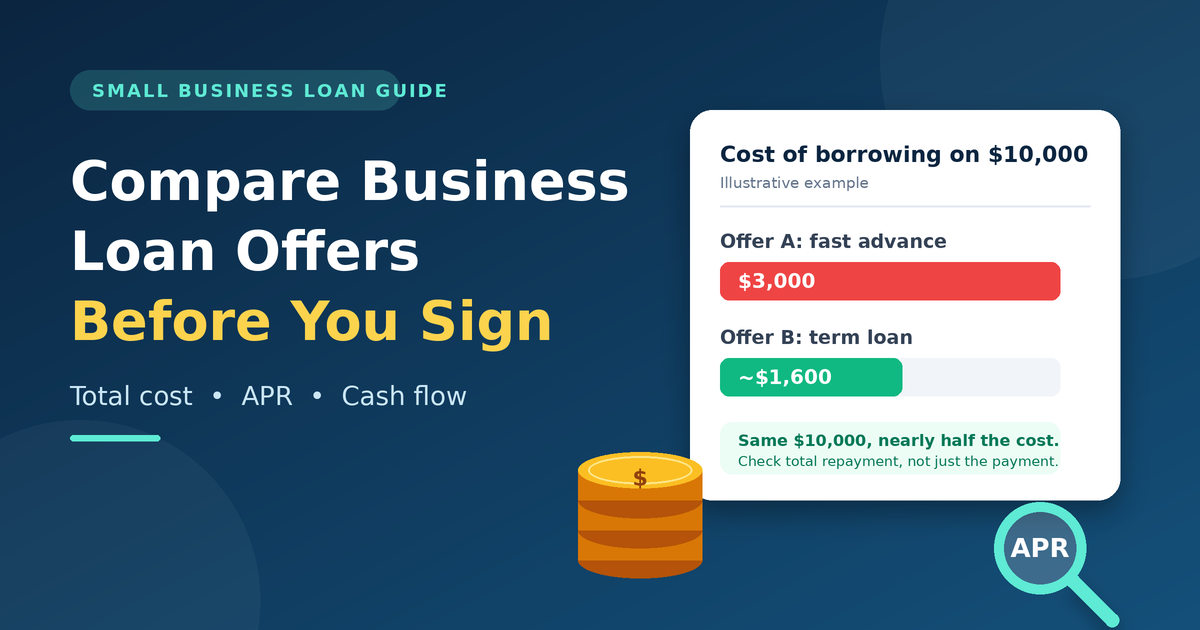
Suppose a small repair shop needs $10,000 for equipment. It receives two offers. The figures below are illustrative, not quotes from any lender.
| Offer A: Fast advance | Offer B: Term loan | |
|---|---|---|
| Amount received | $10,000 | $9,700 after a 3% fee ($300) |
| Cost method | Factor rate 1.30 | 12% APR interest |
| Payment | $500 per week for 26 weeks | About $471 per month for 24 months |
| Total repaid | $13,000 | About $11,298, plus the $300 fee |
| Total cost of borrowing | $3,000 | About $1,600 |
| Approximate APR | Roughly 105% to 110% | About 12% before the fee, higher once the fee is counted |
Offer A has a payment of $500 a week, which sounds manageable, but it costs almost twice as much and takes cash every week, including slow ones. Offer B has a longer commitment but a much lower total cost.
How to check this yourself: multiply the payment by the number of payments, subtract the amount you actually receive, and the result is your cost of borrowing. Then ask the lender for the APR in writing.
Match the payment schedule to your cash flow
A business with strong weekends and slow Mondays can struggle with a rigid weekly debit. Before accepting an offer:
- Look at your last 6 to 12 months of income by week or month.
- Find your slowest normal month, not your best one.
- Check that the payment is covered in that month while still paying rent, wages, tax and suppliers.
If the payment only works in a good month, the loan is too tight.
Common mistakes small business owners make when borrowing
Most costly loans trace back to a short list of repeatable mistakes. Reading educational resources such as hmjones.net before you apply makes these mistakes much easier to spot.
- Borrowing without a clear job for the money. A loan should solve a specific problem, such as buying a machine or covering a known seasonal gap. Borrowing “just in case” means paying for money you may not use.
- Comparing payments instead of total cost. Two loans with the same payment can differ by thousands of dollars in total repayment.
- Ignoring the payment schedule. Daily or weekly debits can strain a business whose income is uneven, even when the monthly equivalent looks affordable.
- Signing under pressure. Urgency is a sales tactic. A good offer will still be a good offer tomorrow morning.
- Overlooking personal guarantees. If you guarantee the loan personally, your own assets can be at risk if the business cannot pay.
- Borrowing the maximum offered. The most a lender will give you is not the same as the most your business can comfortably repay.
- Skipping the contract. Fees, penalties and default terms often sit in the fine print, not in the advertisement.
Questions to ask every lender
- What is the total amount I will repay, in dollars?
- What is the APR, and how is it calculated?
- Which fees apply, such as origination, servicing, documentation or late fees?
- Is the rate fixed or variable?
- Can I prepay, and is there a penalty or a minimum interest charge?
- Is collateral required? Do I sign a personal guarantee?
- What happens if I miss a payment?
- Is this lender licensed in my state or country, and can I verify it?
Red flags
- Pressure to sign today.
- No written APR or total repayment amount.
- Upfront fees before approval.
- Guaranteed approval regardless of credit or revenue.
- Vague answers about fees or penalties.
- A lender you cannot verify through a regulator, a business registry or independent reviews.
Types of business financing, briefly
| Type | Best for |
|---|---|
| Term loan | Planned investments with predictable returns |
| Equipment financing | Buying machinery or tools; the equipment often secures the loan |
| Line of credit | Smoothing cash flow |
| Government-backed loans (for example SBA loans in the US) | Lower rates and longer terms |
| Merchant cash advance | Emergencies only, if nothing else is available |
For official explanations of each product, see the U.S. Small Business Administration, the Consumer Financial Protection Bureau and the Federal Trade Commission’s small business guidance. Outside the United States, check your national financial regulator.
Which loan fits which situation
The right product depends on what the money is for. The pairings below are illustrative starting points, and availability and terms vary by lender, so always confirm the details directly.
| Situation | Often a good fit | Why |
|---|---|---|
| Buying a machine, tool or vehicle | Equipment financing | The asset often secures the loan, which can lower the cost |
| Smoothing out a seasonal slow period | Line of credit | You borrow and repay as needed and pay interest only on what you use |
| A planned expansion or renovation | Term loan or government-backed loan | Predictable payments over a longer period |
| A short gap between customer invoices | Invoice financing or a short-term line of credit | The borrowing matches the time you wait to be paid |
| An emergency with no other option | A short-term advance, used with great caution | Fast, but usually the most expensive, so calculate the APR first |
Reading about each product on hmjones.net or another educational site before you talk to lenders helps you recognise what is actually being offered and what it is called.
How to use hmjones.net as part of your research
Use hmjones.net, this guide or any educational resource to learn the vocabulary, build your list of questions and understand the main loan types before you talk to lenders. Then verify current rates and terms directly with lenders, and consider speaking with an accountant or business adviser before you sign.
A step-by-step process for choosing a loan
A simple process keeps emotion out of the decision.
- Define the purpose and the amount. Write down exactly what the money will buy and what it will cost, with quotes where possible.
- Estimate the return with a cautious number. How much extra income or savings will this create each month? Use a conservative figure, not a hopeful one.
- Collect at least two or three offers. One offer gives you nothing to compare against.
- Put the offers side by side. Record the amount you actually receive, the payment and its frequency, the number of payments, all fees, the total repaid, the APR and any prepayment terms.
- Test each offer against your slowest month. If the payment only works in a good month, move on.
- Read the full contract and ask questions. Anything unclear should be explained in writing before you sign.
- Wait a day and get a second opinion. An accountant or business adviser can catch problems you may miss.
If the vocabulary is new to you, spend some time on hmjones.net or similar resources before step 3, so the offers make sense when they arrive.
How to prepare before you apply
Lenders respond better, and offers tend to improve, when you arrive prepared. Before you apply, gather the following:
- The last 12 months of business bank statements
- Recent tax returns and a profit and loss statement
- A short description of what the money is for and what you expect it to return
- A list of your existing debts and their monthly payments
- Your personal and business credit information, where it is relevant
- The list of questions from this guide
Spending an hour on hmjones.net and similar guides before your first call with a lender helps you ask better questions and notice vague answers.
Frequently Asked Questions
Is the lowest monthly payment the best business loan?
Not necessarily. A low payment is often the result of a longer term or added fees, both of which can raise the total you repay. Compare the total repayment amount and the APR, then check the payment against your slowest month.
What is the difference between interest rate and APR?
The interest rate is the price of the money itself. APR also includes fees, so it shows the fuller yearly cost. Ask each lender for the APR in writing.
What is a factor rate, and how does it compare with an interest rate?
A factor rate is a flat multiplier applied to the amount you borrow. A 1.30 factor rate on $10,000 means you repay $13,000, however quickly you pay. Because repayment periods are short, the equivalent APR can be far higher than the number suggests.
How do I calculate the total cost of a business loan?
Multiply the payment by the number of payments, then subtract the money you actually receive after fees. For example, 26 weekly payments of $500 on $10,000 received costs $3,000 to borrow.
Should I take the fastest loan if I need cash quickly?
Speed has a price. If you must borrow fast, still calculate the total repayment and compare at least two or three offers. Waiting even a day often reveals fees or a payment schedule that does not fit your cash flow.
What documents do lenders usually ask for?
It varies, but common requests include recent bank statements, tax returns, financial statements, proof of business registration and identification for the owners. Online lenders may ask for less, while government-backed loans usually ask for more.
Do I need collateral or a personal guarantee?
Some loans require collateral, such as equipment or property, and some require a personal guarantee, which makes you personally responsible if the business cannot pay. Ask about both before you apply and get the answers in writing.
Can I pay off a business loan early?
Often yes, but check first. Some lenders charge a prepayment penalty or a minimum interest amount, so paying early may save less than you expect.
How can I tell if a lender is legitimate?
Confirm the lender is licensed where required, check the business in your regulator’s or registry’s records, search the lender’s name together with the word complaints, and read the full contract before paying any fee. Be wary of upfront fees before approval and of guaranteed approval offers.
Can I negotiate business loan terms?
Often yes, especially on fees, collateral and prepayment terms, if you have solid financials or competing offers. Ask for changes in writing before you sign.
Key takeaways
- Compare total repayment and APR, not just the payment.
- Test every offer against your slowest month.
- Get fees, penalties and the APR in writing.
- Treat very fast, “guaranteed” offers with caution.
- Use education sites such as hmjones.net to prepare, and verify details with lenders and a qualified adviser.
Final thoughts
A good business loan is one your business can repay comfortably in a slow month and that earns or saves more than it costs. It is rarely the fastest offer, the loudest advertisement or the one with the smallest payment. Read more loan related articles on Britannica En
The habits that protect you are simple: define what the money is for, compare the total cost and the APR, test the schedule against your cash flow, read the contract and give yourself time. Use hmjones.net as a starting point for learning the terms, verify everything with lenders, and take your time before signing. A careful decision today protects your business tomorrow.
This article is for general information only and is not legal, tax or financial advice. Figures are illustrative.